Aura One was developed by dentists with a clear goal: to translate the findings of decades of research on tooth whitening into a modern at-home whitening system.

Chromophores are colour-giving molecules within the hard tooth substance. Their chemical structure influences which wavelengths of visible light are absorbed – and therefore how light or dark a tooth appears.

Hydrogen peroxide is a small molecule and can diffuse through enamel and dentin. In the process, reactive oxygen species form and react with the chromophores within the tooth structure.

Oxidation reactions chemically alter the structure of the chromophores. Their ability to absorb visible light decreases – the tooth appears lighter.
Professional tooth whitening does not act exclusively on surface stains from coffee, tea or nicotine. The most important intrinsic target lies in the dentin: peroxide oxidises the aromatic amino acids of dentin phosphoprotein and thereby lightens the tooth colour — without demineralising the tooth substance (Jiang et al., 2018). That is why whitening can genuinely lighten the intrinsic tooth colour – rather than merely removing surface stains.
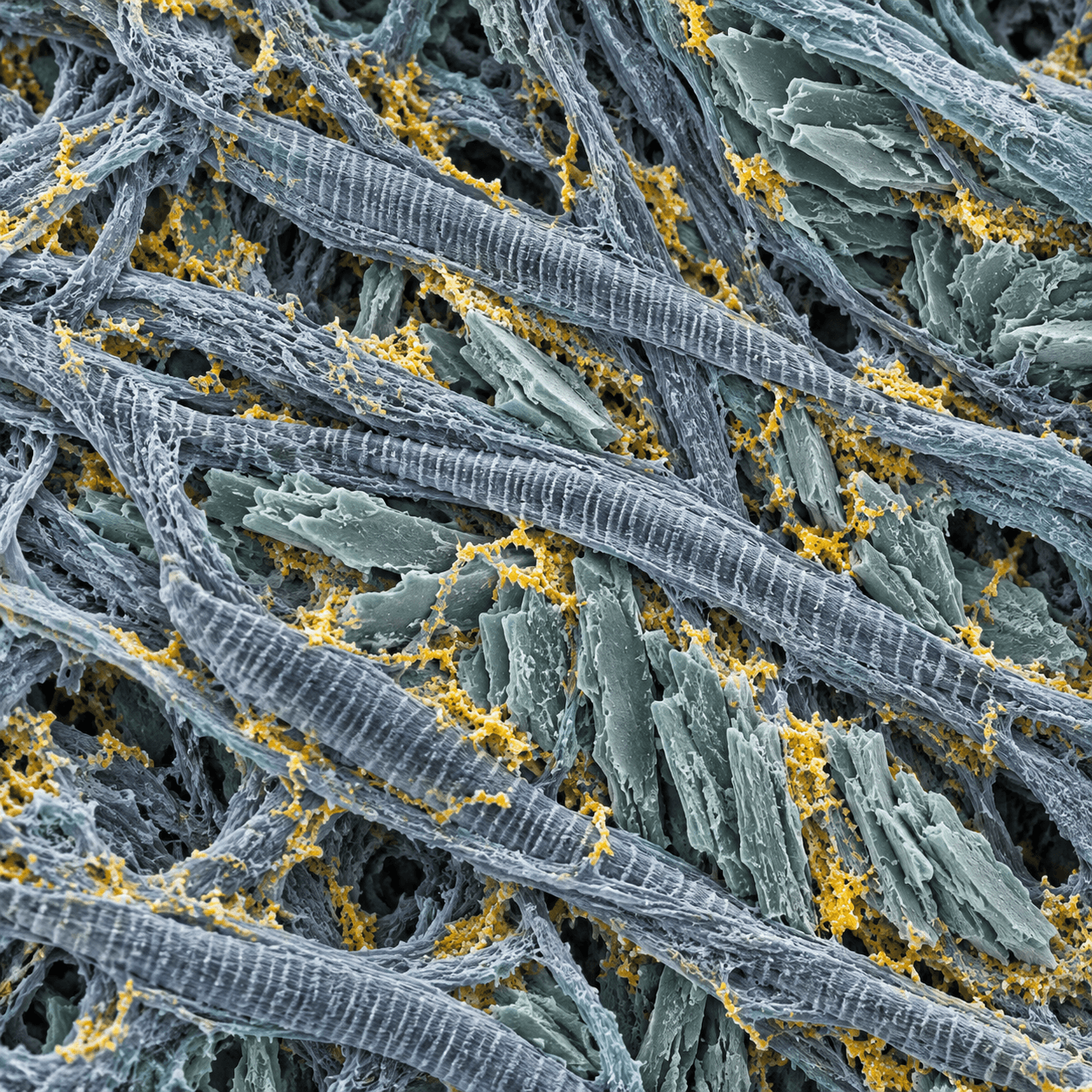
Once the chromophores have been completely broken down and the matrix proteins oxidised, they cannot re-form — the result is stable. If they are only partially cleaved (exposure too short), the fragments recombine and the colour returns. That is why complete whitening up to the natural limit (the bleaching potential) is the basis for lasting results.
Bleaching efficacy of at home 16% carbamide peroxide. A long-term clinical follow-up study.
DOI: https://doi.org/10.1111/jerd.12560Prognosis in home dental bleaching: a systematic review.
DOI: https://doi.org/10.1007/s00784-023-05069-0Nightguard vital bleaching: a long-term study on efficacy, shade retention, side effects, and patients' perceptions.
DOI: https://doi.org/10.1111/j.1708-8240.2001.tb01021.xNightguard vital bleaching: side effects and patient satisfaction 10 to 17 years post-treatment.
DOI: https://doi.org/10.1111/j.1708-8240.2011.00479.xSafety and stability of nightguard vital bleaching: 9 to 12 years post-treatment.
DOI: https://doi.org/10.1111/j.1708-8240.2002.tb00523.xWhitening remained significantly maintained over 42 months; the yellow values (b*) were reduced by about a third and stable
Llena et al., 2020
of the patients who were not retreated, 85% were still satisfied after an average of 12.3 years (Boushell et al., 2012); in a ~10-year follow-up, only 1 of 30 returned to the baseline shade
Ritter et al., 2002
Shade retention compared with baseline after 47 months
Leonard et al., 2001
A clinical comparative study showed that it took three separate in-office sessions to achieve the result of a single 21-day at-home whitening course (Basting et al., 2012). Updated meta-analyses find an at least equivalent, in some cases even greater objective colour change for at-home whitening (De Geus et al., 2025; Donassollo et al., 2021: +4 vs. +3 shade steps). The same result — with one treatment appointment instead of three.
Several controlled studies report lower sensitivity with at-home whitening compared with in-office protocols (De Geus et al., 2025; Donassollo et al., 2021). In review articles, the sensitivity rate is around 51% (at home) versus around 63% (in-office) (Aidos et al., 2024).
A systematic review found less relapse of discolouration with tray-based whitening compared with in-office (Butera et al., 2024); a comparative study with 2-year follow-up showed less regression in the at-home group (Mondelli et al., 2011); in-office results declined faster (Moghadam et al., 2013).
Sachliche Einordnung
Tray-based whitening achieves the same or a better end result — with fewer treatment appointments, lower sensitivity and better long-term stability. The impressive immediate effect of a single session is also partly due to temporary dehydration of the tooth and subsides again.
Hydrogen peroxide releases its active oxygen quickly: in an in-vitro study, a 6% HP product released around 88% of its peroxide within just 30 minutes (Dias et al., 2021). This explains why a daily wear time of around 60 minutes is sufficient. However, the complete breakdown of the chromophores up to the bleaching potential comes from repeating applications over days and weeks — short single treatments only achieve a partial breakdown.
Hydrogen Peroxide Release Kinetics of Four Tooth Whitening Products — In Vitro Study.
DOI: https://doi.org/10.3390/ma14247597Sensitivity is the most common side effect of whitening. Potassium nitrate, with or without sodium fluoride, statistically significantly reduces the risk and intensity of sensitivity — without impairing the whitening result (Wang et al., 2015; Martini et al., 2021). Aura One contains both potassium nitrate and fluoride. Potassium nitrate acts on the transmission of stimuli in the dental nerve, fluoride seals the dentinal tubules — an additive effect.
Evaluation of the efficacy of potassium nitrate and sodium fluoride as desensitizing agents during tooth bleaching treatment — A systematic review and meta-analysis.
DOI: https://doi.org/10.1016/j.jdent.2015.03.015Topical application of a desensitizing agent containing potassium nitrate before dental bleaching: a systematic review and meta-analysis.
DOI: https://doi.org/10.1007/s00784-021-03994-6Comparison of in-office and at-home bleaching techniques: An umbrella review of efficacy and post-operative sensitivity.
DOI: https://doi.org/10.1016/j.heliyon.2024.e25833An in-vivo study with peroxide over several applications found no change in the enamel surface (no increased roughness) (Cadenaro et al., 2008). Temporary changes in microhardness are compensated by remineralisation — supported by saliva and fluoride. The professional consensus: at approved concentrations and with proper use, whitening is safe for the tooth substance.
Enamel surface morphology in vivo.
DOI: https://doi.org/10.2341/07-89Two independent systematic reviews with meta-analysis (2024), evaluating only clinical studies, found no statistically significant difference in at-home whitening results between patients on a restricted diet and those who ate and drank without restriction — including coffee, tea and red wine (Münchow et al., 2024; Hardan et al., 2024). With Aura One, your patients do not have to give anything up during treatment.
White diet is not necessary during dental bleaching treatment: A systematic review and network meta-analysis of clinical studies.
DOI: https://doi.org/10.1016/j.jdent.2024.105459Is a White Diet Necessary for Tooth Bleaching Procedures? A Systematic Review and Meta-Analysis.
DOI: https://doi.org/10.3390/dj12040118Controlled studies show that reservoirs do not improve whitening (Martini et al., 2020) and that, compared with scalloped tray margins, there is no difference in gum irritation, comfort or gel retention (Carneiro et al., 2022). What matters is the precise fit — and a gap-free gingival seal. That is exactly why Aura trays end in a straight line reaching 3–5 mm onto the gingiva: this ensures an uninterrupted gingival seal that reliably keeps the gel on the tooth and saliva out (saliva would neutralise the peroxide). For the same reason we deliberately do without reservoirs — they could weaken the gingival seal. The exact dosing is handled instead by the dosing dots. A thin, reservoir-free tray with a straight, slightly extended margin: equivalent effect with a reliable seal, better wearing comfort and easy handling.
Evaluation of reservoirs in bleaching trays for at-home bleaching: a split-mouth single-blind randomized controlled equivalence trial.
DOI: https://doi.org/10.1590/1678-7757-2020-0332Gingival irritation in patients submitted to at-home bleaching with different cutouts of the bleaching tray.
DOI: https://doi.org/10.1007/s00784-022-04401-4A meta-analysis of 21 randomised controlled trials found no efficacy benefit from light activation; any effect is attributed to the warming of the gel, not to the light itself (Maran et al., 2018).
In-office dental bleaching with light vs. without light: A systematic review and meta-analysis.
DOI: https://doi.org/10.1016/j.jdent.2017.11.007Register for free and without obligation, complete the certified online training and then try Aura One with your personal free test kit.